Super

Payday Super Legislation is Now Law: What Employers Need to Know

The Australian Government has passed the Payday Super legislation and it has received Royal Assent. Payday Super will take effect from 1 July 2026. This new law requires employers to pay superannuation guarantee (SG) contributions on payday and ensure that funds reach employees’ super accounts within seven business days, instead of quarterly or monthly. If you’re an employer, this blog will help you understand how Payday Super will affect your payroll processes.

What employers need to know

  1. Payment Timing:
    • 1. Super must be paid within seven business days of each payday.
    • 2. If a new employee is hired or an employee changes their super fund, first-time payments must be received by the fund by the end of the 20th business day and after each payday.
    • 3. Super on out-of-cycle or bonus payments may be included in the next regular pay cycle, however this does not apply to the termination of employees.
    • 4. The ATO May extend time-frames for events such as natural disasters or systems outages.
  2. Qualifying Earnings: The law introduces the concept of ‘qualifying earnings’ for super calculations. This concept will replace the dual “salary or wages” vs “ordinary times earnings” model. One qualifying-earnings base will simplify administration. It is important to note that amounts which are salary sacrificed to a superannuation fund count toward qualifying earnings and cannot offset required SG.
  3. Maximum Contributions Base (MCB): The maximum contributions base will now be an annual limit, as opposed to quarterly. The calculation will be Concessional Cap x 100 divided by the current SG rate i.e. $30,000 x 100 divided by 12 = $250,000.
  4. Stricter Penalties: There are tougher penalties for late or missed payments. As per current rules, should contributions be missed or paid late, a penalty known as the Superannuation Guarantee Charge (SGC) is created which includes interest and penalties. This won’t change under Payday Super rules, however the penalties will be more robust including:
    • Administrative uplift: 60 % of unpaid amounts (may be reduced by regulation);
    • Late-payment penalties: 25% – 50% of outstanding charge if not paid within 28 days of notice;
    • Additional ATO penalties: up to 200 % for repeated or unreported breaches.
  5. Tax Deductibility: Late contributions and the SGC will be tax deductible. However, any late payment penalties related to the SGC will not be deductible.
  6. Onboarding: The process for onboarding new employees will need to be more streamlined in order to minimize fund rejection errors, such as incorrect employee master data and choice of fund information. Employers need to consider automated solutions to replace manual processes.

What employers should do now

  • Update Payroll Systems: Ensure your payroll software can process super payments on every payday. Also ensure that the super funds you pay are ready for Payday Super.
  • Educate Staff: Inform payroll and HR teams about the new requirements. Also inform your employees.
  • Review Staff Contracts: The advent of Payday Super will require changes to the wording in employee contracts. It may also affect remuneration for some employees – this requires close scrutiny and review.
  • Monitor Compliance: Regularly check that payments are made on time to avoid penalties. Running some test scenarios prior to the advent of Payday Super would be prudent. This would allow employers to iron-out the kinks and deal with potential bottle necks and issues.
  • Change to Payday super Now: You don’t have to wait until Payday Super begins in July 2026. You can start doing it now as long as your processes and software are up to par. If you start now, you will be able to ensure that all or any issues are removed before Payday Super becomes compulsory.

My opinion

Because it is a pet-hate of mine when employers don’t pay employees’ super on time (or at all), I am 100% in support of Payday Super. This new law will ensure that super gets into employees’ super accounts on time and regularly, rather than quarterly, or longer, or sadly, not at all. More regular super payments will see employees’ super balances increase due to higher interest accrued. All good in my book.

I do note, however, that there will be logistical issues such as the super funds not processing the payments within 7 business days and employers paying the super towards the latter end of the 7 day period. This in turn could expose employers to late payment penalties which may occur through no fault of their own. The tight processing time-frame is definitely going to be a problem.

There will also be cash flow issues for employers. Employers will need to ensure that they have enough funds on hand to pay super on payday, from 1 July 2026 and for each and every payday going forward. The current 3 month grace period will be no longer which could put many employers under considerable cash flow stress. Management of cash flow will become extremely important.

Another issue could lie with software companies not being ready to cope with these changes by 1 July 2026, given this is only 7 months away! This is unlikely, but definitely possible.

Lastly, those employers who outsource the processing of payroll will be hit with higher charges due to the extra administration required on payday to process super payments. What would have been a quarterly or monthly job will now become a weekly, fortnightly, bi-monthly, etc. job, depending on the pay cycle used. This aspect will also affect employers’ cash flow!

Payday Super won’t be without its hiccups, but I do believe it will vastly improve the superannuation system, ensure employees are better off, and stop rogue employers from ducking and weaving when it comes to paying employees’ super.

Key Takeaways

  • The Australian Government passed the Payday Super is law, requiring employers to pay superannuation contributions on payday from 1 July 2026.
  • Employers must ensure super payments are made within seven business days and streamline onboarding processes to reduce errors.
  • The new law introduces ‘qualifying earnings’ for super calculations and a stricter penalties regime for late payments.
  • Employers should update payroll systems, educate staff, review contracts, and monitor compliance ahead of the change.
  • Despite potential cash flow issues and logistical challenges, the Payday Super law aims to improve employee superannuation outcomes.

Like it? Share it!

Payday Super Legislation is Now Law: What Employers Need to Know Read More »

New Criminal Underpayment Laws have Started

New Criminal Underpayment Laws began on 1 January 2025. It is now an offence to underpay your staff. If found guilty, you may face hefty fines or jail time, or both. Read on to find out what these laws mean and how you can avoid a conviction going forward.

What are these laws?

Employers found to be intentionally underpaying staff by Fair Work, will be investigated. If a case can be raised, it will be referred for criminal prosecution. If an employer is convicted, he/she may face prison time and/or fines (see below).

Employers who have made an honest mistake and did not intend to underpay staff, will not be prosecuted.

How to protect yourself

Fair Work has created the Voluntary Small Business Wage Compliance Code. This Code can be used to check if you are paying your staff correctly. Employers who have complied with the Code in relation to an underpayment, cannot be referred for possible criminal prosecution by Fair Work. Therefore, if you suspect that you may have underpaid staff, it is in your best interests to review the above Code ASAP!

Another way to protect yourself is to write an Cooperation Agreement. This is an agreement between Fair Work and an employer that outlines a possible underpayment event. While the agreement is in force, Fair Work cannot refer the matter for possible criminal prosecution, however, civil enforcement may apply regardless.

Which fines and prison time can apply?

For a company

If the court can determine the amount of the employer’s underpayment, the maximum fine will be the higher of:

  • 3 times the amount of the underpayment
  • $8.25 million.

If the court can’t determine the amount of the underpayment, the maximum fine is $8.25 million.

For an individual

The court can impose a maximum of 10 years in prison or a fine, or both.

If the court can determine the amount of the employer’s underpayment, the maximum fine will be the higher of:

  • 3 times the amount of the underpayment
  • $1.65 million.

If the court can’t determine the underpayment, the maximum fine is $1.65 million.

How to avoid all of the above

Simple really! Good employers do two things:

1. Stay up to date with payroll obligations including changes to awards, legislation and employees’ circumstances such as their roles, duties, classifications, relevant qualifications, age, hours of work or location of work.

2. Reach out to reliable sources for help when difficult payroll situations arise. These may include bookkeepers, tax agents, payroll HR associations, payroll processing services, industrial associations and Fair Work.

If you are reading this and are concerned about your situation, now might be the time to reach out to your tax professional and ask for assistance. Fair Work mean business!!

Late edit:

Fair Work have released their long awaited Payroll Remediation Guide.  You can download it here. This Guide is directed more to larger employers, where a large number of underpayments or number of impacted employees are identified, or where the issues detected are complex and involve multiple industrial instruments.

Like it? Share it!

New Criminal Underpayment Laws have Started Read More »

PayDay Super is Coming

Payday Super is coming! Payday Super aims to stop employers from not paying employees super or paying it late. The premise is that super will need to be paid after each pay run, even termination pay runs. Payday Super is set to begin from 1 July 2026.

Two proposed models for Payday Super implementation are:

  1. “Employment payment” model: Employers must pay SG contributions on the same day as wages.
  2. “Due date” model: SG contributions must reach the superannuation fund within a specified time after payday.

Both depend on the definition of “payday,” which includes any payment with an ordinary time earnings component, even outside the regular pay cycle like termination payments or bonuses. SG contributions would be calculated based on the ordinary time earnings paid on payday.

Payday Super will have specific impacts on the Super Guarantee Charge process and the maximum contribution base calculations. The government will consult with key stakeholders and the public to ensure these impacts are minimal.

The Government will finalise the Payday Super framework in the 2024–25 Budget. Legislation will be introduced for the measure set to begin on 1 July 2026. The ATO is consulting and co-designing with digital service providers for implementation.

In the meantime, employers must consider how Payday Super will affect their payroll processes and cash flow. It is also important to note that by July 2026, the super rate will be 12% which will also impact business cash flow. There are lots of issues to consider here and I will keep you updated as more information about Payday Super comes to hand.

Note: The government has released draft legislation to mandate payday super, a policy that was first flagged in the 2023-24 Federal Budget.

You can view the draft legislation here.

Like it? Share it!

PayDay Super is Coming Read More »

ATO Super Clearing House to Close when PayDay Super Begins

You may have heard that Payday Super is coming in July 2026. In short, Payday Super will require all employers to pay their employees’ super on the same day as a pay run is processed. The main reason behind this measure is that the Government wishes to end non-payment and underpayment of super by some employers as this is effectively wage theft. The measure will also mean that millions of employees will receive higher retirement savings due to their super contributions being paid earlier and more frequently.

What you may not know is that from 1 July 2026, the ATO Small Business Super Clearing House (SBSCH) will close. Yes, you heard right—it is closing its doors at the same time as Payday Super begins.

So, what can you do to prepare if you are a current SBSCH user? Your options are limited. You can either move to your default super fund’s clearing house or use the super functionality in your payroll software, such as Xero, MYOB, or QBO. I recommend not waiting until the SBSCH closes to get this organised. Make the change as soon as practicable.

How did I hear about the SBSCH closing? I read the fact sheet from the Government Treasury website. You can access the fact sheet here if you wish to read the details behind Payday Super.

The fact sheet breaks down many other details about Payday Super and is an important read if you are an employer. I suggest you take the time to review it and figure out how you will apply this change to your payroll processes when the time comes.

Like it? Share it!

ATO Super Clearing House to Close when PayDay Super Begins Read More »

Super to be paid on Paid Parental Leave

Good news has arrived for those planning a family in the next year or so. The government has decided to pay super guarantee equivalent payments on government-funded Paid Parental Leave (PPL). This will begin from 1st July 2025 i.e. for any babies born or adopted on or post this date. This measure is now law.

While Services Australia will continue to facilitate the PPL process, the ATO will be responsible for paying the super component (not employers). The ATO will pay the super in a lump sum at the start of the following financial year at the then super rate of 12% plus any interest owing. The first payments will be processed in July 2026.

This is a step forward in ensuring that those who choose to be stay-at-home parents are not disadvantaged in terms of future retirement savings. This is a good thing! A fairer system for all!

Like it? Share it!

Super to be paid on Paid Parental Leave Read More »

New from Xero: reprocess failed or returned auto super payments

Xero users who use the payroll function will be pleased to hear that an update has been released whereby failed or returned super payments can now be reprocessed.

Failed Auto Super Payment

If a super payment has failed, the payment authoriser will receive an email notification, outlining the reason for the failure. The status of the payment will change from “pending processing” to “failed”. When this happens, the payment can be reprocessed as the batch will become available for selection in the “Add Super Payment” screen again. Details of the steps required to reprocess failed payments can be found in the above link.

Returned Auto Super Payments

As for failed payments, the authoriser will receive an email if a super payment is returned with information about which employees are affected. Xero can’t tell you why the payment was returned so you will have to contact the super fund affected to obtain those details.

In Xero, the payment status will change to either “partially returned” or “returned”, depending on how many employees are affected.

To find out how to reprocess returned auto super payments, go to the link above.

My Thoughts?

I think this update is an improvement overall, however, the following details from the above link about the timing of the status change to “failed”, have me a bit concerned:

‘This can take up to five business days, with further delays during peak processing times, such as at the end of a quarter. While waiting for the failure message, you can’t update the status of the batch manually.’

Given that the ATO states that “contributions are considered ‘paid’ when they are received by the super fund not when they are paid to the commercial clearing house”, the delays as described by Xero could trigger a Super Guarantee Charge requirement depending on the payment dates involved. This will adversely affect the employer and his/her cash flow, given the SGC increases the super liability overall. This seems a little unfair especially if the employer did pay the SG in a timely manner (or thought he/she did!).

I guess, the only remedy here is to ensure that SG is paid as early in the month as possible so that if any payments are returned or fail, they can be rectified well before the super payment cut-off dates. This issue will become null and void of course, when Payday Super begins (I hope!).

Like it? Share it!

New from Xero: reprocess failed or returned auto super payments Read More »

Think you can get away with not paying your employees’ super? Think again!

Employers intentionally not paying their employees’ super has always been a bugbear of mine. If you follow my Twitter (X) account, you may have seen the hashtag I use: “#notyourmoney“. I use this hashtag because I believe that employee superannuation is not your money and never will be and I want to enforce this concept. These irresponsible employers anger me. It is completely wrong to hire people and then fail to fulfill the contract you agreed upon, which includes paying their super. In my opinion, not paying super is equivalent to stealing.

In the past, employers were able to get away with this unacceptable behavior because the Australian Taxation Office (ATO) only found out about it when employees reported them. At that point, the ATO would investigate, audit, and penalise these employers. This reactive approach has resulted in an estimated $2.5 billion shortfall in unpaid super. This is a truly disgraceful situation.

But things are about to change…

In the 2023-24 Federal Budget, it was announced that the ATO will receive $40.2 million for super compliance measures. This funding includes $27 million for data matching capabilities to identify and take action on cases of Superannuation Guarantee (SG) underpayment, as well as $13.2 million for consultation and co-design.

So what does this mean? Who/what will the ATO be data matching with?

Firstly, it is now widely known that the ATO receives payroll data from employers through Single Touch Payroll events (STP). This data includes the superannuation amounts owed to employees’ super funds. The ATO also receives information about employees’ super from the Australian Prudential Regulation Authority (APRA) through the Member Account Transaction Service (MATS). MATS is a reporting service used for more frequent and detailed reporting of member super contributions and transactions. The ATO utilises the information from both sources to identify potential non-compliant behaviour by employers.

With increased funding from the budget, the ATO will intensify data-matching activities between STP and MATS. This shift from a reactive to a proactive approach means that the ATO will be able to initiate audits themselves instead of relying on employees to report non-compliance after the fact.

It is important to note that this data-matching activity is not new. It has been ongoing since 2019, with the ATO reporting a 24% increase in investigations of super non-compliance. What is new is the improved data matching capabilities enabled by better technology and more comprehensive STP data.

The ATO is now more focused than ever on addressing super non-compliance. They have the necessary tools and resources to conduct investigations and audits on a large scale.

This makes me feel more positive about this problem. I sincerely hope the ATO succeeds in its efforts. I have a strong aversion to employers who think they can evade paying super. It is essentially stealing, a white-collar crime. Thanks to the ATO’s real-time monitoring, the likelihood of getting away with non-payment of super is rapidly decreasing. And that is a very good thing!

Like it? Share it!

Think you can get away with not paying your employees’ super? Think again! Read More »

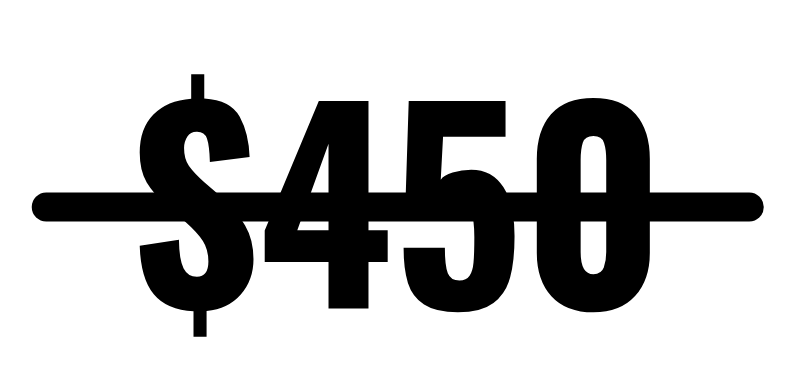
$450 Super Guarantee Threshold Scrapped!

As part of the Government’s Treasury Laws Amendment Bill 2021 which passed on 12th February 2022, it has been decided that the $450 superannuation guarantee threshold will be removed. This will begin on July 1, 2022. 

The scrapping of the threshold will make about 300,000 more workers eligible for super contributions, including many low-income employees in part-time and casual positions. This will ensure all workers can build their retirement savings, not just those in higher-paid, full-time positions.

Currently, employees must gross a minimum of $450 per month with one employer in order to be paid super on top of those wages (note, this can be $350 per month for those working in the hospitality industry e.g. award MA000009 Hospitality Industry). Those who work casually or part-time may find that they never quite reach that threshold even if they hold several jobs at once. For example, an employee who has 3 casual jobs, earning $300 per job per month, will not receive super on any of those wages due to the $450 threshold. This hardly seems fair and is the main driver for the removal of the threshold.

So, from July 1, 2022, if you employ staff, you will need to pay super contributions on all their earnings, no matter how little each month. For example, if your employee grosses $100 for the month, then super of $10 (currently paid at 10%) will accrue and be paid to the employee’s super fund.

While the move to remove the super threshold is pleasing in my opinion, it is worth noting that employers’ payroll budgets will increase as a result. The cost to employ staff is currently very high and this change will only serve to make it higher! Add in the next super guarantee increase to 10.5%, also from 1 July 2022, and I think we shall see some employers squirming!

While your payroll software will more than likely be upgraded to take up the removal of the super threshold, it is worth noting the start date to ensure you can check your payroll setup is correct when the time comes.

Like it? Share it!

$450 Super Guarantee Threshold Scrapped! Read More »

Stapled Super Funds

In an attempt to protect and improve workers’ retirement savings, the Government announced super reforms “Your Future, Your Super”. This was passed into law on the 24th of June 2021.

As part of these new laws, how you, as an employer, deal with new employees’ super funds and subsequent payment into those funds, has changed.

From 1st November 2021, when a new employee starts working for you, you must pay their super into their “Stapled Super Fund” if he/she does not provide you with a choice of fund.

What is a Stapled Super Fund (SSF)?

An SSF is an existing super account that is linked or “stapled” to an employee so that it follows him/her around when he/she changes jobs.

Why do we need Stapled Super Funds?

In the past, it was common for employees to end up with multiple super accounts, especially when employers paid super into their default super funds. Having multiple accounts means that employees are unwittingly paying fees from each account which can add up to a lot of lost retirement savings. From the ATO, “the change aims to reduce account fees by stopping new super accounts being opened each time an employee starts a new job”.

How do you know when you need to use a SSF and how do you do it?

Currently, when a new employee starts working for you, you must provide him/her with a Super Standard Choice Form to complete. The form will provide you with the employee’s super details. If the employee fails to provide these details to you, you must then find out what his/her SSF is and pay super into that fund.

A request for an SSF for your employee is done via Online services for Business (or your Tax/BAS Agent can do it for you). If you cannot access Online Services, you can ring the ATO on 13 10 20 to make the request. When you log into your online account, go to the Business tab, then Employee Super Accounts, then click on “request”. Follow the prompts and you will be provided with the SSF within minutes.

Please note, that you will not be able to make an SSF request until the ATO has confirmed that you are the employee’s employer. This is done via either them receiving the Tax File Number Declaration details or by an STP lodgement event.

How is a SSF determined by the ATO?

The ATO will find the fund that has had the most recent contribution paid into it. This will become the employee’s SSF.

What if a SSF is not provided by the ATO?

If this happens and your employee has still not provided his/her super details, you may make payments into your default super fund.

What happens if the SSF rejects the payment?

If this happens, the ATO recommends that you make another request. If the same SSF is provided, then you must call the ATO on 13 10 20 for assistance.

Is there a transition period?

Yes! The ATO is providing a transition period. This will be between 01/11/2021 and 31/10/2022. After this period has ended, the ATO may apply penalties should you fail to comply with the Stapled Super Fund rules.

Summary – see our infographic below (free to download)

  1. Stapled Super Funds begin on 1st November, 2021.
  2. Only request SSF for employees who do not provide their super details to you.
  3. SSF requests are done via Online Services for Business or your Tax/BAS Agent can make the requests on your behalf.
  4. If an SSF does not exist, you may make super payments for the employee into your default super fund.

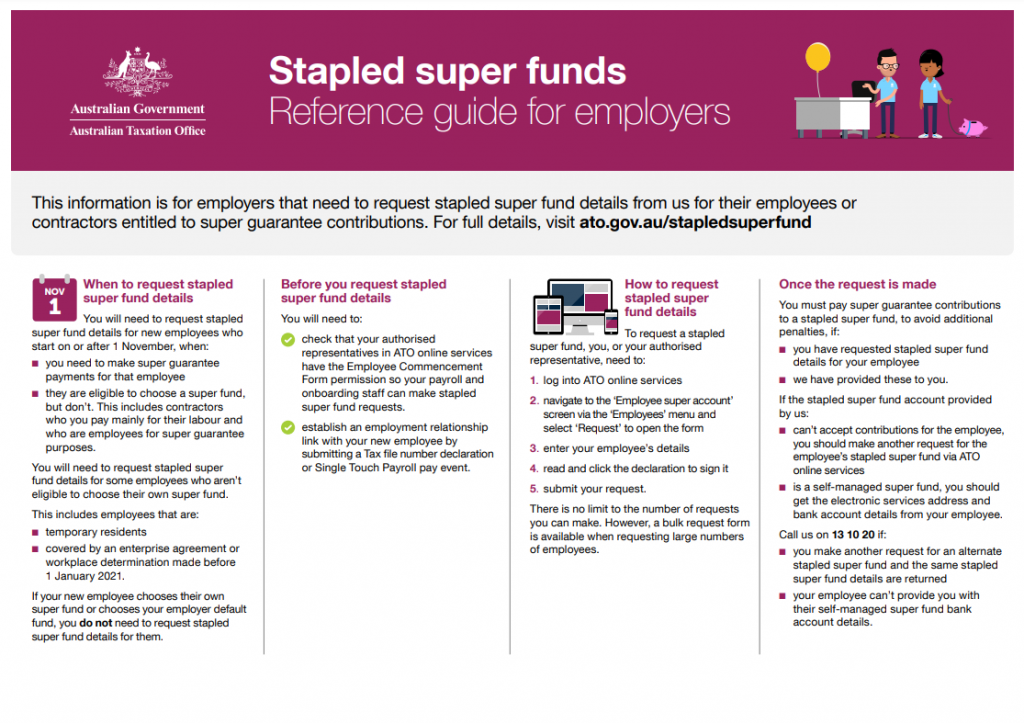
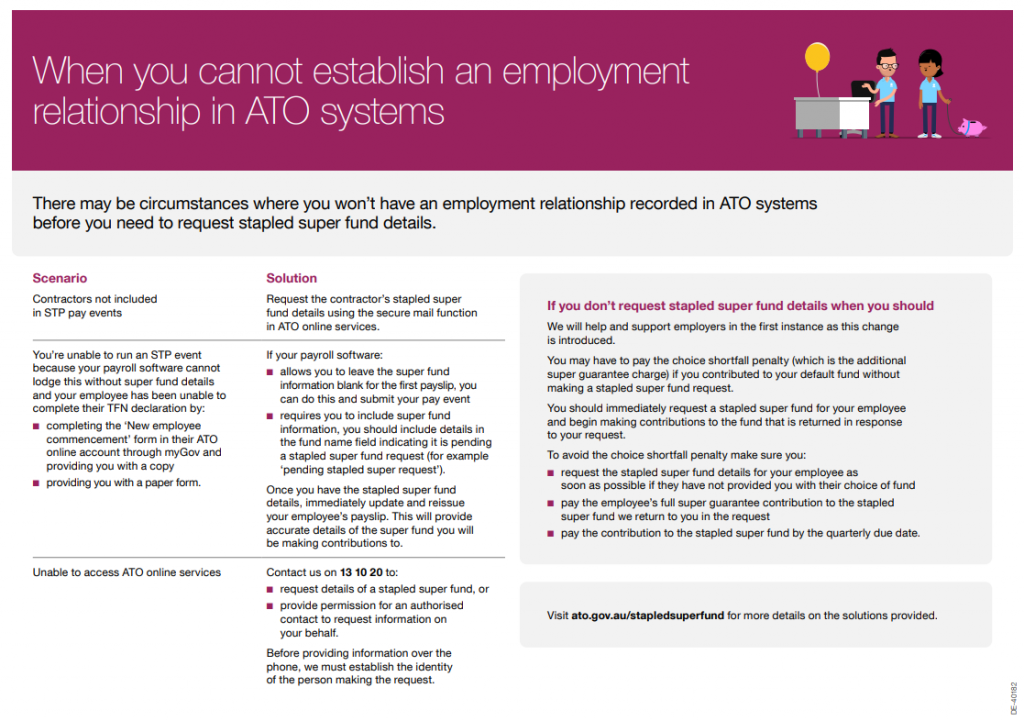
Need more help? Here are 2 reference guides from the ATO

Like it? Share it!

Stapled Super Funds Read More »

Superannuation Services Extended

A new legislative instrument has been released which has extended the services BAS Agents can provide to clients in relation to the super guarantee charge (SGC). BAS Agents have been able to assist clients with superannuation tasks for approximately 2 years now, but this instrument allows them to do more and be of greater benefit to clients.

BAS Agents can currently offer superannuation services to clients like processing, advising upon and lodging monthly/quarterly superannuation guarantee data. The Tax Agent Services (Specified BAS Services Services No. 2) Instrument 2020, as it is known, will allow BAS Agents to expand upon these services to include the following tasks in relation to SGC:

  • Act as an authorised contact on behalf of clients with the ATO in relation to SGC accounts, payment arrangements, penalty remissions, super audit and/or review activity;
  • Advising clients when the superannuation guarantee (SGC) charge applies and why;
  • Advising clients about offsetting late payments of superannuation contributions against the SGC;
  • Completing the late payment offset election section of the SGC statement;
  • Acting on behalf of clients in relation to lodging the SGC statement.

The instrument will also allow BAS Agents to view and access superannuation guarantee and SGC accounts in online services.

If you are a BAS Agent and would like to read the detail of the new instrument, here is the link to the Explanatory Statement.

The new legislation means that we can now assist clients with superannuation services on a much higher level and therefore provide more value than before. We have added these new services to our services page where you can also view other services we provide.

If you would like to find out more about the superannuation guarantee charge, go to this ATO webpage.

Like it? Share it!

Superannuation Services Extended Read More »

Scroll to Top